Garage Door Stuck Halfway? What's Jamming It
A garage door that stops partway is the most awkward failure there is. The car is either blocked in or blocked out, and the house is open to anyone who wants to duck under. It also tends to happen on the way to somewhere, which is exactly when people do the one thing that turns a moderate repair into an expensive one.
This covers what actually jams a door halfway, how to tell which cause you have from where it stopped, and what to do about the opening in the meantime.
Stop pressing the button
This is the first instruction because it is the most expensive mistake, and almost everyone makes it. The instinct when a door stops is to press the remote again, and then again.
Here is what that does. The opener is built to guide a door that the springs are already counterbalancing, and it moves that door with a plastic drive gear transferring rotation from the motor to the rail. When the door is jammed, the gear takes the full resistance of whatever is blocking it. Each retry strips a few more teeth off it. That is how a jam that would have been a repair in the $175 - $450 range turns into a replacement opener at $350 - $600, on top of fixing whatever caused the jam in the first place.
Press once. If the door does not move freely, stop, and pull the emergency release to disconnect the opener from the door before doing anything else. That takes the opener out of the equation entirely and lets you assess the door itself.
What jams a door halfway
Six causes cover almost all of these, and where the door stopped narrows it down quickly.
| What you see | Likely cause | Who fixes it |
|---|---|---|
| Stops at the same height every time | Obstruction, or a dent in the track at that point | You, if it is an object |
| Door sits crooked, one side higher | Cable off the drum or snapped | Technician |
| Grinding or scraping, door binds | Roller out of its track | Technician |
| Visible gap in the spring coil above the door | Broken spring | Technician |
| Stops short, then reverses on its own | Travel limits or photo-eyes | You, both adjustable |
| Very heavy on the manual release | Counterbalance failure | Technician |
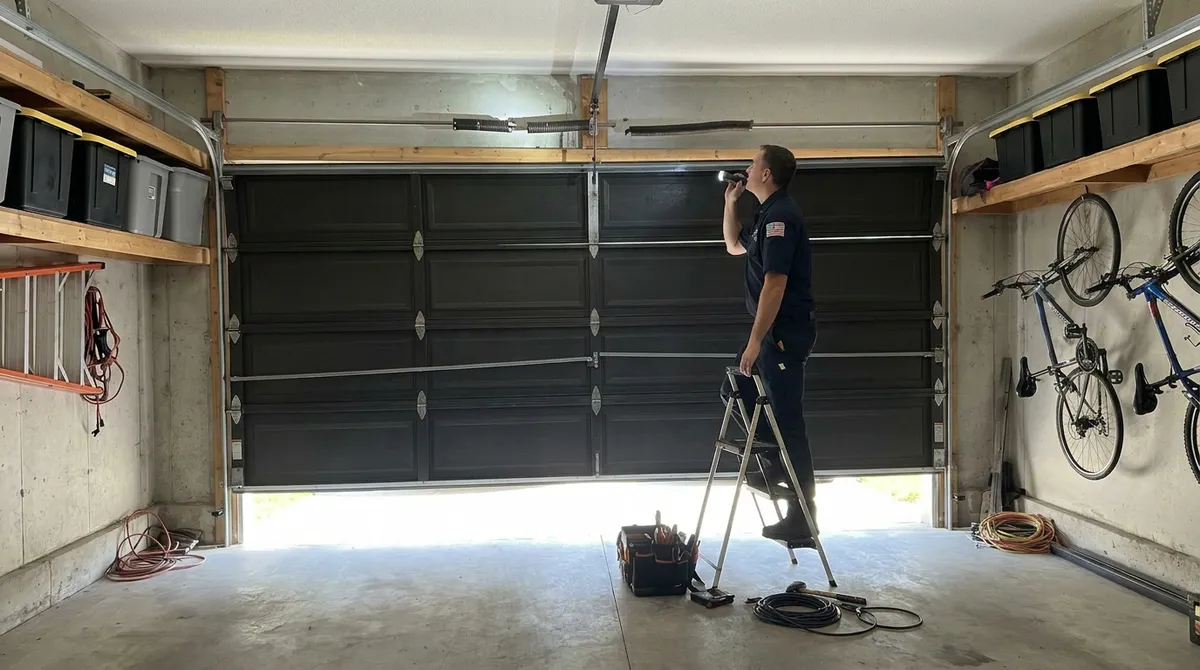
The quickest diagnostic is the manual release. Pull the cord to disconnect the opener, then try to move the door by hand. If it slides freely, the door and its counterbalance are fine and the fault is in the opener or its settings. If it will not move, or moves crookedly, or feels extremely heavy, the problem is mechanical and the opener was never the issue.
A door sitting visibly crooked, with one side higher than the other, is the one to treat most carefully. That pattern means a cable has come off its drum or snapped, and the door is being held unevenly.
The two you can clear yourself
An obstruction in the track. Look along both tracks from the floor upward, particularly at the height where the door stopped. Things that get in there: a bike handlebar, a rake leaning in the corner, a bin lid, a bungee hook, garden cane. Remove it, check the track at that point for damage, and cycle the door once slowly while watching it.
Travel limits and photo-eyes. If the door reverses on its own rather than simply stopping, the cause is usually electronic rather than physical. Check that both photo-eye sensors near the floor show a steady indicator light, and wipe the lenses. If the sensors are fine and the door still stops short in the same place, the travel limits need adjusting, and the method varies by opener model.
Neither of those involves the counterbalance system, which is why they are safe. Everything else on the list does.
The four that need a technician
A roller out of its track means the door is no longer travelling in its guide, and forcing it usually spreads the track further. The fix is to release tension, reseat the roller, and check the track has not been deformed.
A bent or spread track is often the consequence of the previous problem, or of the door being hit. The section has to be straightened or replaced, and the door realigned.
A cable off the drum or snapped is the one to leave completely alone. The cables carry the counterbalance load from the springs to the door, and a door held by one cable is held unevenly. Our post on why garage door cables come off covers the causes in detail.
A broken spring stalls the lift. The door may have travelled partway on opener power before the opener gave up against the weight. Look for a visible gap of an inch or two in the coil of the torsion spring above the opening.
The common thread is that all four involve a door under load. A door stuck partway has its weight held by whatever is left of the counterbalance system, and disturbing that without releasing the tension properly is how people get hurt. We do not publish steps for any of them for that reason. If the door has come off its track entirely, our guide to a garage door off track explains what that repair involves.
Securing the house while it is open
The opening is the immediate problem, and it is worth dealing with before the repair.
- Lock the interior door between the garage and the house. That is the actual point of entry into your home, and it is often left unlocked.
- Move anything valuable out of sight from the driveway, particularly tools, bikes and anything with a resale value.
- Keep people and cars out from under the door. Do not park beneath it and do not prop it with anything.
- Do not leave children in the garage while the door is in that position.
If the gap is big enough for someone to get through and you cannot close the door, that is a same-day problem rather than a next-week one. Our emergency and same-day service exists for exactly this, and it is worth saying on the call that the house is open, because it changes how we schedule it.
Tight driveways and salted tracks
Across North York we see two local contributors to jammed doors more than elsewhere, both tied to how the garages sit.
Driveways on semi-detached and narrow-lot homes leave very little room either side of the car. Doors get clipped by mirrors, bumpers and door edges while manoeuvring, and the damage often shows up in the bottom section or the lower track rather than anywhere obvious. The door keeps working for a while, then starts binding at the point where the track was knocked out of true.
The second is road salt. Slush gets carried in on tyres and sits against the bottom track through the winter, and the lower few feet of track corrode faster than the rest. A corroded or pitted track surface catches rollers that used to run through it cleanly, which is why jams often start low and at the same height each time.
Both are worth knowing because both are preventable with a rinse of the bottom track in late winter and a look at the lower track after any knock, however minor it seemed at the time.
Getting it moving again
If the door is stuck and the manual release has not freed it, the cause is mechanical and it needs someone with the tools to release tension safely. We diagnose the fault, quote in writing before starting, and where the opener has taken damage from repeated attempts we will tell you whether it is worth repairing or replacing.
Call 647-930-7997 or book an appointment. If the door is stuck open and your house is not secure, say so when you call and we will treat it as urgent.