Garage Door Replacement Cost: Repair the Old One or Replace It?
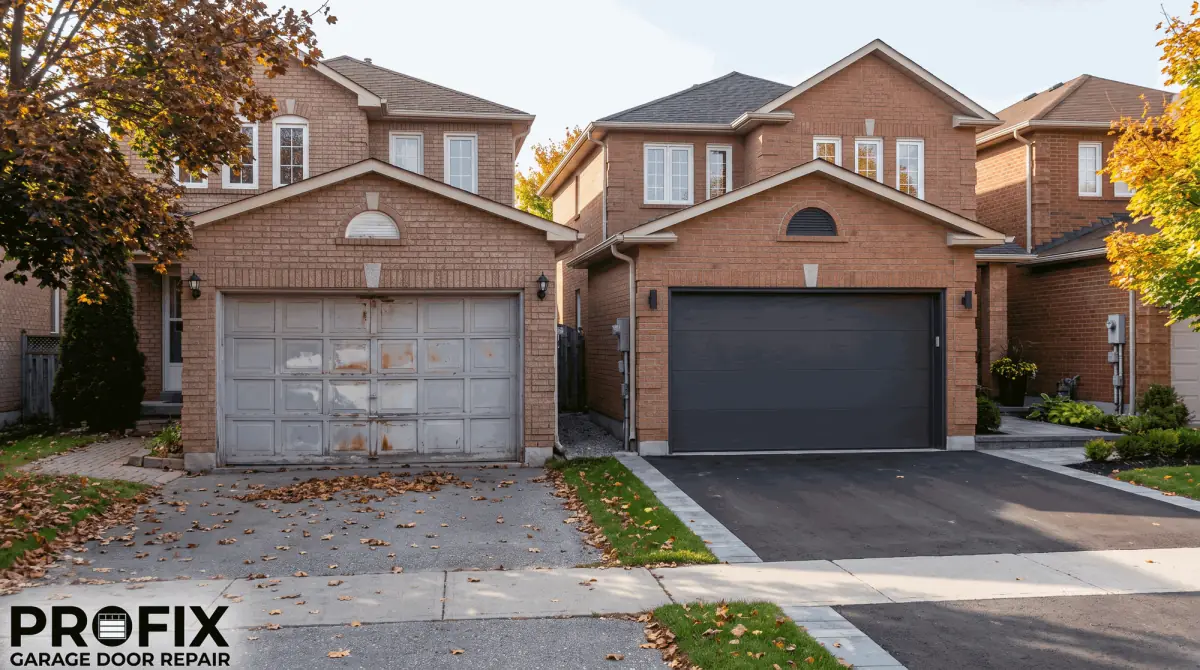
Three service calls in two years is the point most homeowners start doing the arithmetic. The door still opens, mostly, but something fails every few months and the repair bills are adding up toward the cost of simply replacing it. The honest answer is that there is a threshold, it is calculable, and it has more to do with the age of the door than the size of the last invoice.
This covers what a replacement actually costs, what pushes a quote up or down, and the test we use on site to tell a homeowner whether we would repair their door or replace it.
How much does a new garage door cost installed?
There is no single figure, because installed cost is driven by the opening rather than the door. Four variables set the number: single or double width, insulated or single-skin construction, the material, and how much of the existing hardware can be reused. A basic single-skin single door on reusable tracks sits at the bottom of the range. A custom oversized insulated door with new tracks and a re-sized spring system sits at the top, and the gap between those two is several times over.
That is why quotes for what sounds like the same job come back so far apart. One may include removal and disposal of the old door, new tracks and re-sized springs; another may assume your existing hardware gets reused and quietly leave the disposal off. Neither is dishonest, but they are not comparable until you line up what each one includes.
The practical step is to get the quote in writing and check four line items: removal and disposal, tracks and hardware, spring re-sizing for the new door’s weight, and whether the existing opener is being reused or replaced. Those four are where the variance lives. Every quote we issue is written and itemised before any work starts, for exactly this reason.
The repair-or-replace arithmetic
Two numbers decide it: the repair quote as a share of the replacement quote, and the age of the door. Neither works on its own. A $400 repair is trivial on a five-year-old door and poor value on a twenty-year-old one, and the same figure gives opposite answers depending on which door it lands on.
| Repair quote vs replacement | Door under 10 years | Door 10 to 15 years | Door over 15 years |
|---|---|---|---|
| Under 25% | Repair | Repair | Repair |
| 25% to 50% | Repair | Repair, watch it | Get both quotes |
| Over 50% | Repair, check the cause | Get both quotes | Replace |
The pattern is straightforward: replace when both tests point the same way, and repair when only one does. A door over 15 years old facing a repair worth more than half its replacement cost is the clear replace case. Everything else deserves a second look before you spend the larger amount.
One qualifier matters more than the table. If a repair is expensive on a young door, find out why before paying it. A cable that came off at year four usually means something else is wrong, such as a drum out of alignment or a door that was never properly balanced, and replacing the door does not fix that underlying fault. It follows the new door in.
What drives the installation cost up
Removal and disposal of the old door is the first item, and it is real work rather than a formality: the door comes down under spring tension and the hardware goes with it. A quote that omits it is either absorbing it or intending to charge for it later.
Track reconfiguration is the second. If the new door is a different thickness or weight from the old one, the existing tracks may not suit it, and headroom above the opening determines what track type is even possible. A garage with limited headroom needs a low-headroom track kit, which costs more than standard hardware.
Spring re-sizing is the item most often missed, and the one most likely to cause a callback. Springs are sized to the weight of a specific door. Fit a heavier insulated door to springs calculated for the old single-skin one and the door is out of balance from day one. The opener then carries weight the counterbalance should be taking, which strips its drive gear early. Any quote for an insulated replacement should show spring re-sizing as a line item, and if it does not, ask.
Reusing the opener is usually fine and usually saves money, provided its horsepower suits the new door. Where a replacement opener is needed, a smart opener installed runs $350 - $600, which is a separate decision from the door itself and worth treating that way.
When repairing is clearly the right call
Plenty of doors get replaced that had years left in them. A single bent panel on a door that is otherwise square, sound and correctly balanced is a repair, not a replacement, as long as the model is still in production and a matching panel can be sourced. The limiting factor is availability rather than damage: on a discontinued door a mismatched panel is obvious from the street, and that is what pushes those jobs toward full replacement.
Failures isolated to hardware are the same story. Springs, cables, rollers and hinges are wear items with a defined service life, and replacing them on a sound door is routine work in the $175 - $450 range. A door under ten years old with one failed component is not telling you it is finished. It is telling you a part reached the end of its cycle count.
The case for stopping repairs is cumulative rather than dramatic: multiple systems failing in the same year, panels that no longer line up when the door is closed, rust through the bottom section, or a door that has been hit and never sat correctly since. That pattern says the door is done. A single part failure does not.
- Repair: one bent panel on a current model, a failed spring or cable, worn rollers, a door under ten years old
- Get both quotes: repeated failures across different systems, panels no longer meeting cleanly, a door in its teens
- Replace: rust through the bottom section, a frame the door no longer sits square in, a discontinued door needing cosmetic panels
Oversized and custom doors change the maths
Wide and oversized doors are common on the newer builds around Woodbridge, and they shift the arithmetic in two ways. Custom sizes carry a lead time, because the door is built rather than pulled from stock, and they carry more weight, which makes the spring and track specification less forgiving than on a standard opening.
That weight has a practical consequence for the repair-or-replace decision. On an oversized door, hardware wears faster because every component is carrying more load through every cycle, so hardware repairs arrive sooner and more often than on a standard double. Those repairs are still worth doing on a young door, but the threshold for replacement arrives earlier in the door’s life.
It also means an oversized door is the worst candidate for reused springs and a reused opener. If you are replacing a custom door, budget for the counterbalance system to be recalculated, and have the opener’s horsepower checked against the new door’s weight rather than assumed from the old one.
Choosing what to replace it with is a separate question, and material drives both cost and lifespan. Our guide to choosing a garage door material covers the trade-offs, and if the garage is attached or has a room above it, insulated versus non-insulated is worth reading before you commit.
Getting a number you can actually compare
The fastest way to settle this is to get both quotes, for the repair and for the replacement, and apply the table above. Any installer willing to quote only one of the two is not giving you the information you need to decide.
We quote both in writing, itemised, before any work starts. If your door is worth repairing we will say so, and our garage door repair work carries a written warranty on parts and workmanship. If it genuinely is finished, our residential installation quotes include removal and disposal of the old door, tracks, and spring re-sizing for the new door’s weight.
Call 647-930-7997 or book an appointment online and we will measure the opening, look at the door you have, and give you both numbers.