Summer Storms and Power Outages: Keeping Your Garage Door Working
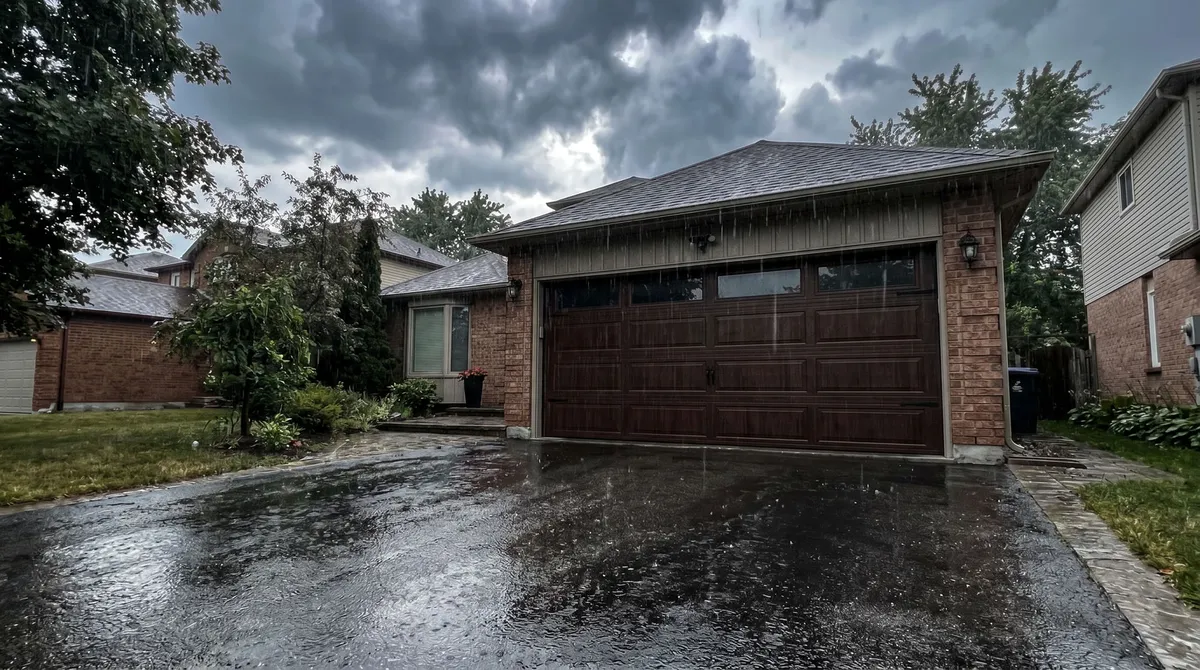
When a summer storm knocks out the power, you can still open your garage door manually using the release cord, and a few simple precautions protect the opener from the surges that come with storm season. Knowing both ahead of time means a storm never leaves you stranded in or out of your garage.
Summer in the GTA brings sudden thunderstorms, high winds, and the occasional grid failure, and your garage door is caught in the middle of all three. Here is how to get in and out during an outage, shield the opener from damage, and check the door after a storm passes.
How Do You Open a Garage Door During a Power Outage?
When the power is out, the electric opener will not run, but every door has a manual override built in for exactly this situation.
Using the Manual Release
Look for the red cord hanging from the opener rail, the trolley that connects the door to the motor. Pulling it disconnects the door so you can raise and lower it by hand.
For safety, do this with the door closed whenever possible. If a spring is weak or broken, a disconnected door can drop, so keep your hands clear of the tracks and never stand directly underneath. Once disconnected, the door lifts by hand and you can get your car in or out.
Reconnecting After Power Returns
When the power comes back, you reattach the trolley to the opener. On most models you pull the release cord back toward the door, or simply run the opener and the trolley re-engages automatically on the next full cycle.
Test the door once afterward to confirm it is connected and operating normally before you rely on it again.
Protecting Your Opener From Power Surges
The bigger long-term risk during a storm is not the outage itself but the power surge that can come with it. A nearby lightning strike or a grid spike can fry the opener’s circuit board in an instant.
Surge Protection
The simplest defence is a surge protector on the outlet the opener plugs into, the same kind you would use for a computer. A whole-home surge protector at the electrical panel adds another layer and protects every appliance at once.
If your opener has died or started behaving erratically right after a storm, a surge is the likely culprit, and the control board may need replacing.
Battery Backup
A growing number of openers include a battery backup, which keeps the door and any smart features working through an outage entirely. In a storm-prone area this is a genuinely useful feature, and it is one of the perks of a modern smart garage door opener.
Storm Damage: Wind, Water, and Debris
Beyond power, a strong storm can damage the door itself, and the effects are not always obvious right away.
High winds can flex or bow a door, especially a non-reinforced single-layer one, and flying debris can dent a panel or knock the door out of alignment. Driving rain can also find its way past worn weather seals, leaving water pooling inside the garage.
After a severe storm, walk the door and look for new dents, bowing, gaps around the seals, or signs of water. A door that now sticks, sits crooked, or sounds different has likely taken a hit that needs attention.
How to Prepare Your Garage Door Before a Storm
A little preparation before storm season, or ahead of a specific severe forecast, goes a long way. The goal is to make sure the door can resist wind, stay sealed against water, and survive a surge.
Run through this short checklist:
- Add surge protection on the opener outlet, and ideally at the electrical panel, before storm season starts.
- Check the weather seals so wind-driven rain does not get under or around the door.
- Test the manual release so you know how to use it before you actually need it in the dark.
- Consider a battery backup if outages are common in your area.
- Clear the area around the door of loose items the wind could throw into it.
- Keep the door closed during high winds, since a closed door is far more wind-resistant than an open one.
A closed, well-sealed door with a protected opener will ride out the large majority of summer storms without trouble.
After the Storm: What to Inspect Closely
Once the weather clears, a careful look at the door catches damage before it becomes a failure, because wind and debris damage is not always obvious from a distance.
Stand inside with the door closed and look for daylight around the edges that was not there before, which signals a bowed panel or shifted alignment. Lift the door, disconnected if needed, and feel for new resistance or grinding. Check the bottom seal and the floor for water that got in during the storm.
If the door opens and closes normally, sits square, and shows no new dents or gaps, it likely came through fine. Anything that looks bent, sounds different, or lets water in is worth a professional inspection before you keep using it.
When to Call After a Storm
Some storm aftermath is worth a professional look rather than waiting to see if it gets worse. Call for service if you notice any of these:
- The opener is dead or erratic after a surge
- A panel is dented, bowed, or cracked from wind or debris
- The door sits crooked or has come partly off its track
- Water is getting in past damaged seals
- New noises or sticking that were not there before the storm
Our emergency and same-day service handles post-storm repairs, and we respond quickly across Vaughan and the surrounding GTA. For broader guidance on sudden failures, our guide on dealing with garage door emergencies is a helpful companion.
If a summer storm has left your garage door damaged or your opener unresponsive, book service online or call us at (647) 930-7997, and we will get your door working safely again.