Garage Door Opener Repair: What Fails, and What It Costs to Fix
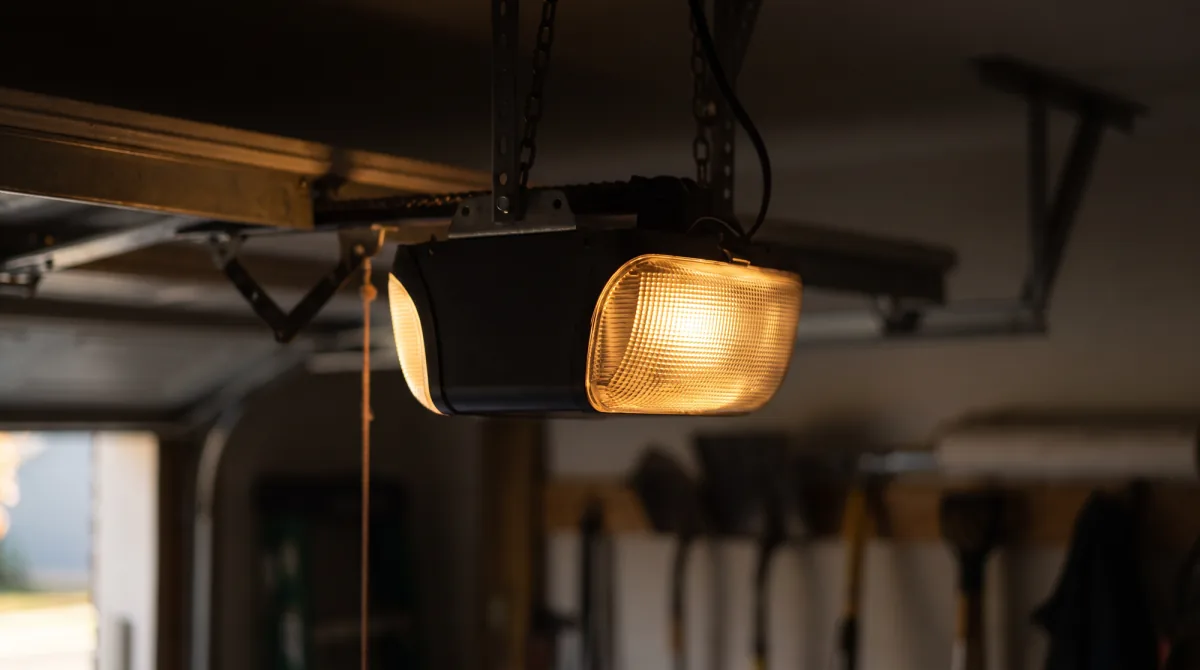
An opener that hums without moving the door, or runs while the door sits still, is rarely a dead unit. It is usually one part, and which part it is determines whether this is an afternoon repair or the moment to replace the whole thing. The difficulty for a homeowner is that five quite different failures produce symptoms that sound alike from the driveway.
This walks through the five components that actually fail, the symptom that identifies each, what the repair costs, and the test for when a new opener is the cheaper answer.
The five parts that actually fail
Opener failures cluster tightly. In the large majority of service calls, one of five components is responsible, and each announces itself differently.
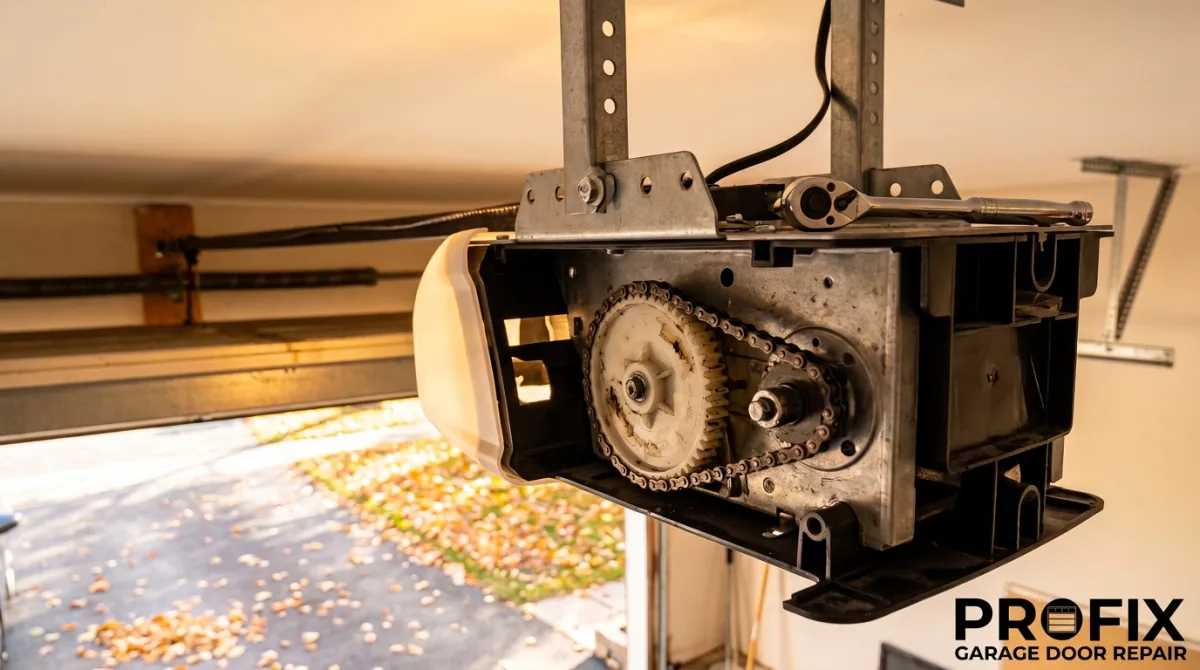
The drive gear is the most common by a wide margin. It is a plastic gear that transfers rotation from the motor to the rail, and it wears its teeth away over years of cycles. The symptom is unmistakable once you know it: the motor runs, often with a grinding or whirring note, and the door does not move at all. It fails early on openers fighting an unbalanced door, because every cycle loads the gear beyond what it was designed to carry.
The capacitor produces a different sound. The unit hums but nothing turns, or the motor struggles to start and then gives up. The capacitor provides the starting torque, and without it the motor cannot get moving under load.
The logic board is the surge casualty. The opener is simply dead: no lights, no response from the wall console or the remote. Power outages and electrical storms are the usual trigger, which is why these calls arrive in clusters after bad weather.
Limit switches and the travel module cause the most misdiagnosed faults. The door stops short of the floor, or reverses partway down, and the owner assumes the opener is failing. The opener is working exactly as told; it has been told the wrong travel distance.
| Symptom | Likely cause | Repairable |
|---|---|---|
| Motor runs, door does not move, grinding note | Stripped drive gear | Yes, common |
| Unit hums, nothing turns | Capacitor | Yes |
| Completely dead, no lights, after a storm | Logic board | Yes, if parts available |
| Stops short of the floor or reverses partway | Travel limits | Yes, often an adjustment |
| Reverses only when closing, sensor light flickering | Photo-eye alignment | Yes, often free |
What opener repair costs
Most opener repairs sit in the $175 - $450 range, which covers the part, the labour and testing the door through a full cycle afterwards. Where a specific repair lands inside that band tracks the component. Travel limit adjustments and sensor realignment are at the bottom. A drive gear replacement is in the middle. A logic board is at the top, because the part itself carries most of the cost.
The number that matters alongside it is $350 - $600, which is a smart opener supplied and installed. Once a repair quote approaches the middle of that range, the arithmetic changes: you are spending most of the cost of a new unit to extend the life of an old one, and the new unit resets the clock on every other component at the same time.
That comparison is the whole decision. A $200 drive gear on a six-year-old opener is obviously worth doing. The same $200 on a seventeen-year-old unit whose board and capacitor are the same age is money spent waiting for the next failure.
Repair or replace: the age and availability test
Age sets the default, and parts availability overrides it.
| Opener age | Default | What changes it |
|---|---|---|
| Under 8 years | Repair | Almost nothing. Repair it. |
| 8 to 15 years | Depends | Parts availability, and repair cost against the $350 - $600 installed bracket |
| Over 15 years | Replace | A trivial fix, such as a limit adjustment or a sensor |
The middle band is where most calls land, and parts availability decides it more often than price does. Manufacturers discontinue models, and once a board or gear set is out of production the repair stops being a question of cost and becomes a question of whether the part exists at all. We check availability before booking a repair on an older unit, because there is no sense charging for a diagnostic on a part nobody can supply.
Safety features are the other consideration in that band. Openers made before 1993 predate mandatory photo-eye sensors, and anything that old should be replaced on safety grounds regardless of what the repair would cost. A rolling-code opener is also substantially more secure than the fixed-code units of that era, where a neighbour’s remote on the same frequency could open your door.
Free checks before you call
Four of these cost nothing and resolve a meaningful share of calls. Do them before booking anyone.
- Check the outlet and the breaker. A dead opener after a storm is sometimes just a tripped breaker. Plug something else into the outlet to confirm it is live.
- Check the trolley. If someone pulled the emergency release cord, the trolley is disengaged from the rail. The motor will run normally and the door will not move, which mimics a stripped gear exactly. Re-engage it and cycle the door.
- Check the wall console lock. Most consoles have a lock or vacation mode that disables the remotes. It gets pressed by accident more often than you would expect.
- Check the photo-eyes. Both sensors near the floor should show a steady indicator light. A cobweb, a leaf, a bike wheel or a slightly knocked bracket will stop the door closing and send it back up.
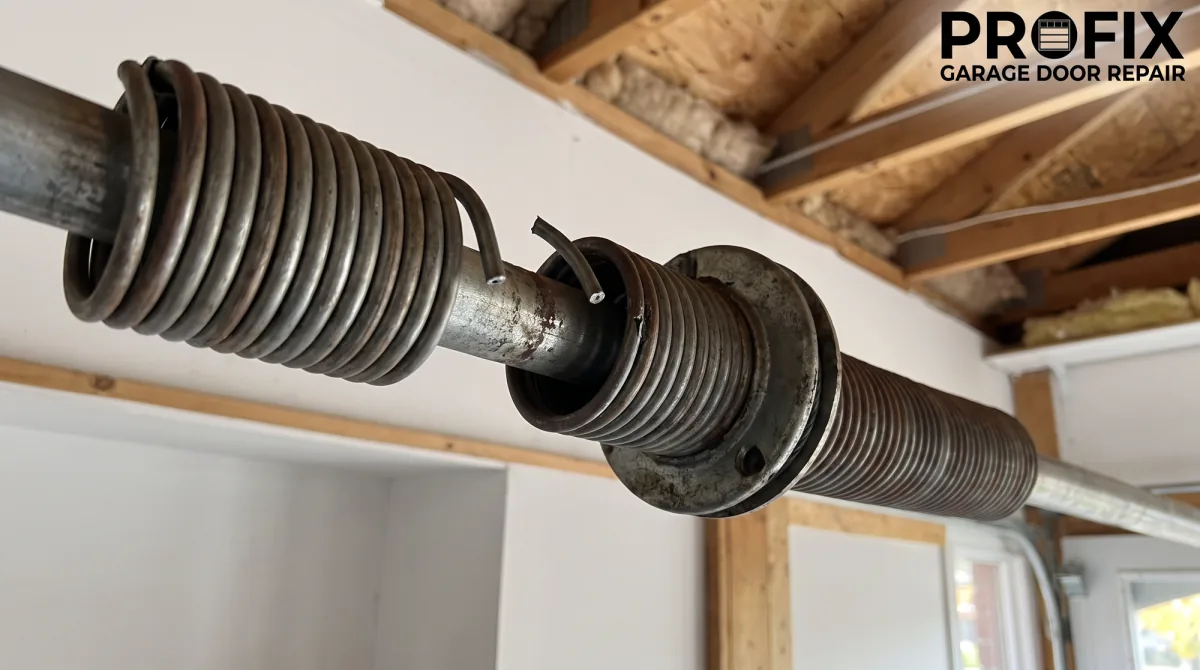
Beyond those four, opener work involves stored electrical energy in the capacitor and a door under spring tension, and it stops being a homeowner job. We do not publish drive gear or board replacement steps for that reason.
Older homes, newer openers
Around Markham we see the full span in one neighbourhood: original wood doors from the 1970s still in service, and smart openers fitted to them. That combination is where opener failures concentrate, and the reason is weight.
A heavy original wood door demands more from an opener than a modern insulated steel one, and an opener specified without accounting for that weight runs at its limit on every cycle. Drive gears on those installations fail years early. The fix is not a better opener; it is confirming the door is properly balanced and the springs are correctly sized before the opener is asked to lift anything.
There is a simple test for it. Pull the emergency release with the door closed and lift the door by hand to waist height. A correctly balanced door stays roughly where you leave it. One that drops or climbs is out of balance, and the opener has been compensating for that imbalance every day. Repair the counterbalance first, or the replacement opener fails the same way the last one did.
If you are choosing a replacement rather than a repair, our comparison of belt, chain and screw drive openers covers which suits a room above the garage, and garage door openers explained walks through horsepower and features.
Getting it diagnosed properly
Most opener problems are one part, and the right first step is identifying which one rather than replacing the unit by default. We diagnose the fault, check parts availability on older models before quoting, and tell you plainly when a repair is not worth doing.
Our garage door opener service covers repair, replacement and installation, and every quote is written before work starts. Call 647-930-7997 or book online, and if the door is stuck open and your house is not secure, say so when you call and we will treat it as urgent.