What Garage Door Spring Replacement Costs in Ontario
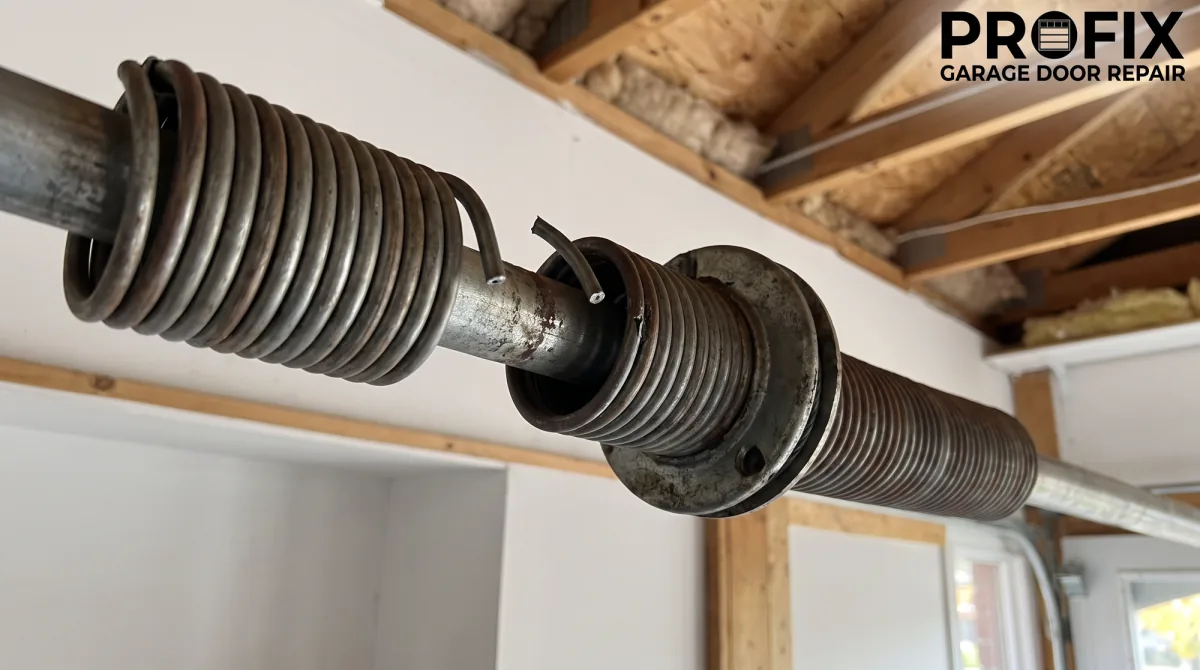
A broken spring is the most common reason a garage door stops lifting, and it is usually the loudest. Most people hear it happen: a bang from the garage overnight, and the next morning the door will not move, or the opener strains and gives up.
The first thing almost everyone wants is a number. Spring replacement falls within the $175 - $450 repair range, and the rest of this explains what moves a job within that band, why you will usually be quoted for two springs when only one broke, and why this particular repair is not one to attempt yourself.
What moves the price within the range
Four things determine where a spring job lands.
One spring or a pair. Most doors run two springs, and on a two-spring system both are normally replaced together. This is covered in detail below, because it is the item that most often looks like an upsell and is not.
Torsion or extension. The two systems mount differently and cost differently to replace. Torsion systems are more involved to work on and generally sit higher in the range.
Door weight. Springs are sized to the specific weight of the door they counterbalance. A heavy insulated double door or a solid wood door needs a heavier spring specification than a light single-skin single door, and the part cost follows.
Cycle rating. A standard spring is rated at roughly 10,000 cycles. A high-cycle spring rated at 25,000 or more costs more up front and lasts proportionally longer. On a busy door, that upgrade is often the cheaper choice over ten years.
What you should expect in every case is a written quote before work starts, itemising the springs, labour, and any cables or drums damaged when the spring let go. Damaged cables are common on a spring failure, because the sudden release of tension is hard on everything the spring was holding.
Why you get quoted for two springs
This is the single most common question on a spring call, and the reasoning is straightforward once you see it.
Both springs on a two-spring door were installed at the same time and have completed the same number of cycles. They are consumable parts with a defined service life measured in cycles, not a component that fails randomly. When one reaches the end of that life, the other is at the same point, and it is a matter of weeks or months rather than years behind.
Replacing only the broken one creates two problems. The first is the return visit, at full price, for a failure you already knew was coming. The second is more immediate: a new spring paired with a worn one produces uneven force across the door. That imbalance loads the opener, wears the cables and drums unevenly, and means the door does not sit correctly through its travel.
There is one legitimate exception. On a genuine single-spring system there is only one spring to replace. If someone quotes you for a pair, ask them to show you the second spring on the shaft.
Torsion and extension springs compared
| Torsion | Extension | |
|---|---|---|
| Where it mounts | On a shaft above the door opening | Along the horizontal tracks, both sides |
| How it works | Winds up as the door closes | Stretches as the door closes |
| Typical lifespan | Around 10,000 cycles standard, 25,000+ high-cycle | Around 10,000 cycles |
| Door balance | More even through the full travel | Less even, more variation |
| Common on | Heavier and wider doors, most modern installations | Older and lighter single doors |
| Relative cost | Higher | Lower |
| Safety containment | Contained on the shaft | Needs a safety cable through the spring |
One point on extension springs is worth knowing if you have them. An extension spring should have a safety cable running through its centre and anchored at both ends. Without it, a spring that snaps under tension becomes a projectile. If your door has extension springs and no safety cables, that is worth correcting whether or not the springs need replacing.
Torsion systems have become standard on newer installations for good reason: they balance the door more evenly through its travel, they are contained on the shaft, and they are available in high-cycle ratings that extension springs generally are not.
What the technician is actually specifying
The part of this job that earns the money is measurement, not installation. A torsion spring is specified by four values: wire diameter, inside diameter, wound length, and wind direction. Those values produce a spring that exactly counterbalances the weight of your door.
Get them wrong and the door is out of balance from the first cycle. Too weak and the opener carries the difference, stripping its drive gear early. Too strong and the door drifts upward when it should stay put, and the safety reverse cannot work correctly.
This is why a spring should be specified from the door rather than copied from the old spring. The old spring is a reasonable starting point, but it may have been wrong to begin with, particularly if the door was replaced at some point and the springs were not re-sized for the new weight. Any competent job ends with a balance test: pull the emergency release, lift the door to waist height by hand, and confirm it stays where it is left.
Cycle rating is the other decision. A household cycling the door four times a day uses roughly 1,460 cycles a year, so a standard 10,000-cycle spring lasts around seven years. A busier household at six to eight cycles a day gets through it in four or five. At that rate, high-cycle springs are usually the better spend, because the labour cost of the second visit is the same whichever spring is fitted.
Builder-grade springs and the year-eight failure
Across the newer subdivisions in Vaughan, there is a recognisable pattern: springs failing at around year eight on homes built within the last decade or so.
The reason is specification rather than defect. Volume builders fit springs that meet the requirement at the standard cycle rating, which is entirely adequate for an average household. Where the household is busier than average, with two cars in and out several times a day, the door reaches 10,000 cycles well ahead of the calendar and the spring reaches the end of its life on schedule.
The practical implication is that if you are in a home of that age and the original springs are still fitted, the failure is predictable rather than random. It is also a good argument for the high-cycle upgrade when the time comes, because the household usage that consumed the first set has not changed.
Why this is not a DIY repair
A torsion spring on a residential door holds enough stored energy to cause serious injury. Winding and unwinding it requires proper winding bars and correct technique, and the common injuries come from improvised tools slipping under load.
That is the whole explanation, and we are not going to publish the method. This is the one repair where the gap between a professional job and a confident amateur one is measured in broken bones rather than in a slightly worse result.
What you can safely do is diagnose it. A visible gap of an inch or two in the coil of a torsion spring means it has snapped. A door that suddenly feels extremely heavy on the manual release, or one where the opener strains and stops, points the same way. Our post on the signs a spring is about to break covers what to watch for before it fails.
If a spring has gone, leave the door closed. Cycling it on the remaining spring puts load through cables and drums that were never meant to take it, and turns a spring job into a spring, cable and drum job.
Getting it quoted
We quote spring replacement in writing before any work starts, sized from your door rather than from the old spring, and we balance-test the door before leaving. If the cables or drums were damaged when the spring let go, that appears on the quote rather than as a surprise afterwards.
Our garage door repair work carries a written warranty on parts and workmanship, and a broken spring on a door you need to use counts as urgent, so say so when you call.
Call 647-930-7997 or book an appointment, and if you are weighing standard against high-cycle springs, tell us how many times a day the door runs and we will tell you which one actually pays back.