Garage Door Sensor Problems: How to Diagnose Misaligned Photo-Eyes
A garage door that opens fine but refuses to close is one of the most common service calls there is, and the culprit is usually the safety sensors. The reassuring part is that this is often a ten-minute fix you can handle yourself.
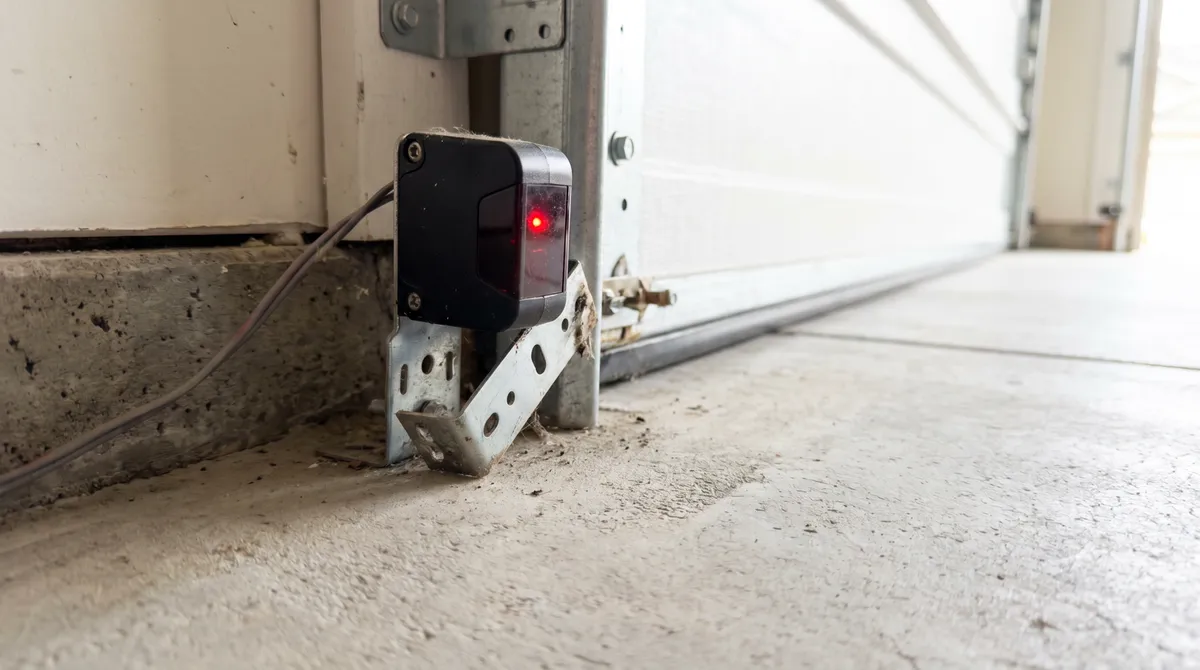
Those two small boxes near the floor, the photo-eyes, project an invisible infrared beam across the doorway. If anything interrupts that beam, the opener reverses or refuses to close as a safety measure, the feature that stops a closing door on a child, a pet, or a car bumper. When the eyes fall out of sync, the door simply will not come down.
Reading the Indicator Lights
Each sensor has a small LED, and learning to read it tells you most of what you need to know before you touch anything.
Solid vs Blinking
A solid, steady light on both sensors means they are aligned and seeing each other properly. If the door still will not close with steady lights, the problem is likely elsewhere, such as the opener’s travel or force settings rather than the sensors.
A blinking light is the classic symptom of a sensor problem. It means the two eyes are not communicating, whether from misalignment, dirt, a blocked beam, or a wiring fault.
Which Sensor Is Which
The two sensors do different jobs. One is the sending unit that emits the infrared beam, and the other is the receiving unit that detects it.
Usually it is the receiving sensor whose light blinks when the beam is lost, while the sending unit stays lit. Knowing which is which saves time, because the sender can sit slightly out of aim and still glow while the receiver flashes for attention.
The Common Causes
Most sensor faults trace back to a short list of everyday culprits. You can usually identify yours by ruling these out in order:
- Dirty lenses - a film of dust, a cobweb, or grime weakening the beam
- Misalignment - a sensor knocked out of aim by a ball, a shovel, or a bumper
- Sun glare - direct afternoon sun washing out the beam at certain times of day
- A blocked path - an object, bin, or tall debris breaking the beam
- Loose or damaged wiring - a pinched, chewed, or corroded wire at the sensor
Start with the simplest. A quick wipe of both lenses solves the problem more often than any other single step, so always clean before you adjust.
The Summer Connection
Sensor trouble spikes in the warmer months for two reasons worth knowing. The low afternoon sun sits at an angle that shines straight into the lenses on east and west-facing driveways, and dust and insects are far more active, leaving film and cobwebs across the beam.
If your door started misbehaving once summer arrived, one of these two is the likely trigger rather than a failing part.
Step-by-Step Realignment
If cleaning does not restore a steady light, the sensors likely need realigning. This is safe to do yourself, since it does not involve the springs or cables.
- Clean both lenses with a soft, dry cloth so dirt is ruled out first.
- Check for obstructions in the doorway and clear any debris from around each sensor.
- Loosen the wing nut on the bracket of the blinking sensor just enough to move it by hand.
- Aim it squarely at the opposite sensor, adjusting slowly until the indicator light turns solid.
- Tighten the wing nut while holding the position, then test by closing the door.
If the light goes steady and the door closes, run it a couple of times to confirm the fix holds. A door that reverses rather than refusing to close outright can point to the same sensors, which our guide on why a door reverses before closing covers in more detail.
A Quick Trick for Stubborn Glare
If sun glare is the issue, a small hood or shield over the affected sensor can block the direct light without interrupting the beam. A short length of dark tubing or a purpose-made sensor shield does the job, and slightly repositioning the bracket away from the sun’s angle helps too.
When It Is Wiring, Not Alignment
Sometimes a sensor blinks no matter how carefully you align it. When that happens, the issue is usually electrical rather than positional.
Signs of a Wiring Fault
Look for a wire that is pinched, chewed by a rodent, corroded at the terminal, or pulled loose from its staple along the track. A sensor that has physically cracked or taken a hard knock can also fail outright.
These faults are harder to chase down and sometimes call for a replacement sensor or a fresh run of wire. That is the point where a professional diagnosis saves time and guesswork.
When to Call for Help
If you have cleaned, realigned, ruled out glare, and the light still will not go steady, the cause is likely wiring or a failed sensor that needs a closer look.
Our garage door repair service handles sensor diagnosis and replacement, and we provide repair across Woodbridge and the surrounding area. If the door will not close and the sensors check out, our guide on what to do when a garage door will not close walks through the other causes.
If your sensors keep blinking and the simple fixes have not worked, book a repair online or call us at (647) 930-7997, and we will get your door closing safely again.