Garage Door Stuck Closed in Freezing Weather
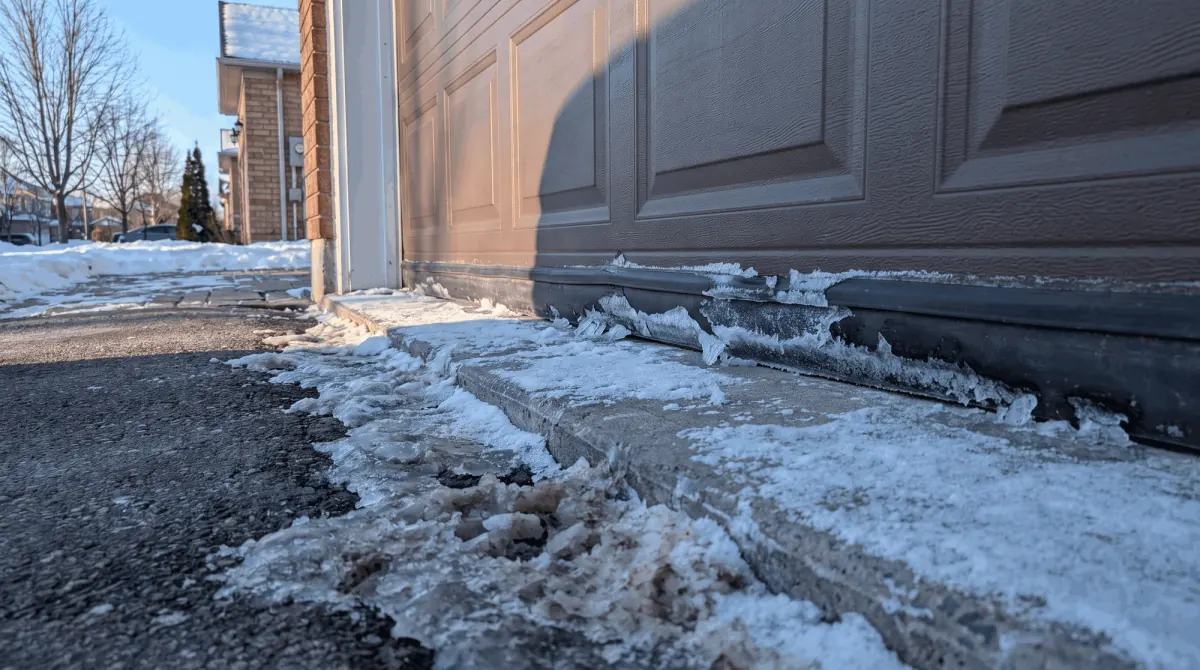
The first properly cold morning after a wet day is when these calls arrive. The door will not open, the opener strains and gives up, and the car is on the wrong side of it. In most cases nothing has broken. The door has frozen to the slab overnight and it is effectively glued down.
The important thing is telling that apart from an actual mechanical failure, because the two demand opposite responses and one of them gets considerably worse if you keep pressing the button.
Frozen to the slab, or actually broken?
Disconnect the opener first. Pull the emergency release cord to take the opener out of the equation, then assess the door by hand. This single step prevents most of the expensive outcomes.
If the door is frozen, it resists at the bottom edge while the rest of the door has a little give. Lifting it produces flex at the very bottom while the upper sections move slightly. When the bond releases, it does so suddenly and audibly, with a distinct crack. The door is otherwise normal.
If a spring has broken, the door feels extremely heavy across its whole width, with no flex at the bottom and no cracking noise. It will not lift more than an inch or two by hand, and you may have heard a bang from the garage overnight. Look at the torsion spring on the shaft above the opening for a visible gap of an inch or two in the coil.
| What you notice | Frozen seal | Broken spring |
|---|---|---|
| Weight by hand on manual release | Normal once released | Extremely heavy immediately |
| Flex at the bottom edge | Yes, slight | No |
| Sound on release | Audible crack | None, it simply will not lift |
| Bang heard overnight | No | Often |
| Gap visible in the spring coil | No | Yes |
| Improves as the day warms | Often | Never |
That last row is a useful confirmation. A frozen door frequently releases on its own by early afternoon. A broken spring is identical at four in the afternoon as it was at seven in the morning.
Freeing a frozen door safely
Work on the seal, not on the door. The bond is between the rubber weatherseal and the concrete, and that is where the effort belongs.
- Pour warm water along the seal line. Warm, not boiling. Boiling water on very cold concrete risks cracking the slab, and it refreezes fast into a worse problem than you started with.
- Work a plastic scraper along the edge where the seal meets the concrete. Plastic, not metal, because a blade will cut the seal and you will be replacing it.
- Use a hair dryer if water is impractical, held at a distance and kept moving along the seal rather than concentrated in one spot.
- Once it releases, open the door fully and leave it open for a few minutes.
- Dry the seal and clear the slab. Sweep out slush and standing water from the strip the seal sits on. Skip this and you will be doing the whole thing again tomorrow morning.
That is the complete safe procedure. It deals with the large majority of winter calls and costs nothing.
What not to do
Three things turn a free fix into a bill, and all three are common.
Do not hold the button down. This is the expensive one. The opener is designed to guide a door that moves freely, not to break a door away from the floor. Holding the button drives the motor against a fixed object, and the plastic drive gear inside strips its teeth. That converts a frozen seal into a repair in the $175 - $450 range, or a replacement opener at $350 - $600.
Do not use a metal blade on the seal. Chisels, scrapers and screwdrivers cut the rubber. A damaged seal holds more water against the slab, which makes tomorrow worse, and replacing it runs $50 - $150.
Do not pour boiling water on the slab. The thermal shock can crack cold concrete, and the water refreezes into a thicker layer of ice than you removed.
And if the door is not frozen but genuinely stuck, forcing it is the wrong move for different reasons. Our guide to a door stuck partway covers the mechanical causes and why a door under load should be left where it is.
When it is not ice
Cold weather causes two other failures that present as a door that will not open, and neither is fixed with warm water.
A spring that has broken in the cold. Steel contracts slightly at low temperatures and becomes less forgiving, so a spring already close to the end of its cycle count is most likely to fail on the first hard freeze. The cold did not wear the spring out; several years of cycles did. The cold simply provided the final stress. This is why spring calls spike in the first cold snap every year and why it feels like the weather broke something that was fine yesterday.
A seized roller or stiffened lubricant. Grease that has thickened in the cold can leave a roller skidding rather than turning, which binds the door in the track. This is one reason the lubricant matters: a product suited to cold weather stays workable where a heavier grease does not.
Neither of these is a homeowner repair. Both involve a door under counterbalance load, and a broken spring in particular means the door’s weight is no longer supported as designed. Leave it closed and call rather than cycling it on the remaining spring, which puts uneven strain through the cables and drums.
Stopping it happening again
Prevention here is genuinely effective and takes very little effort.
- Clear slush and standing water from the slab before a freeze, especially the strip directly under the seal
- Check the bottom seal for hardening, cracking or flattening. A seal that no longer compresses holds water against the concrete
- A thin film of silicone spray on the seal, not on the concrete, reduces its tendency to bond
- Book the tune-up before winter, not during it. A pre-season service at $90 - $180 covers lubrication with a product suited to cold, spring tension, hinge and roller condition and a balance test
The seal is the component that does most of the work here. Our guide to garage door weather stripping covers when to replace it and how to tell a seal that is past its useful life.
The coldest part of the region
Around Newmarket and the northern end of our service area, winter arrives earlier and holds harder than it does closer to the lake, and the pattern in our call volume follows it every year.
The freeze-thaw cycling is what does the damage rather than the absolute temperature. A day that reaches a few degrees above zero melts snow on the driveway, that meltwater runs toward the garage and pools at the door, and the overnight drop refreezes it around the seal. Repeat that a dozen times through January and the seal takes a beating quite apart from the door being stuck each morning.
It also means the first hard freeze up there arrives before most people have thought about the garage door at all. A tune-up in October rather than December is the practical response, because a spring that is going to fail in the cold will generally show its age on a balance test first.
When to call
If the door is frozen and the warm-water approach has not released it, or if the checks above point at a broken spring rather than ice, it needs someone out. A broken spring with the car inside is a same-day problem, and worth saying so when you call.
Our emergency and same-day service covers exactly this through the winter, and we quote in writing before starting. If your opener took a beating before you realised the door was frozen, we will tell you honestly whether the gear is damaged or whether it survived.
Call 647-930-7997 or book an appointment.